24 October 2013

Before Midnight DVD Review

No comments:

Rating:
15
Release Date:
28th October 2013 (UK)
Distributor:
Sony Picture Classics (UK)
Director:
Richard Linklater
Cast:
Ethan Hawke, Julie Delpy, Seamus Davey-Fitzpatrick
Buy Before Midnight:DVD [Amazon]

Before Midnight is the 3rd film in the most unlikely film franchise ever made. It started with the tiny budget Before Sunrise and followed 9 years later with Before Sunset. Neither film were smash hits but were critically acclaimed universally. Before Sunset even got an Oscar nomination for screenplay. It’s credited as directed by Richard Linklater but it’s more of collaboration between the director and it’s leads Ethan Hawke and Julie Delpy, who are credited as screenwriters on the 2 sequels.

It all started with Before Sunrise, which came out in 1995 that concerns a brief encounter between Jesse (Ethan Hawke) and Céline (Julie Delpy) in Vienne in their early 20s. They have a night together after meeting on a train and they wander aimlessly in Vienne and fall in love. They realise they will probably never see each other again and decide not to swap contact details.

The saga continued in Before Sunset, Jesse has written a book about their night together and it’s a bestseller. He Is on European book signing/reading tour and is in Paris and Céline pops by to say hi to an old friend. Jesse has a kid and is married but his love with Céline is rekindled and he famously misses his plane in the last scene.

Before Midnight is set 9 years after the events of the last film. Jesse and Céline have married and parented twin girls. Jesse’s son from his previous relationship is staying with them for summer in Greece but he has to fly home to Chicago to stay with his mother. Jesse has continued writing to great success but Céline is at a crossroads about her career and is debating to work for the French Government. The two of them go to dinner with some writer friends and they buy them a hotel for a night so they can have a night together. Jesse and Céline arrive at the hotel but tensions mount between the two and breaks into an argument.

The Before trilogy is one of the very few honest depictions of a romantic relationships on films. They are so often sentimental and unrealistic. The 1st 2 films are so hopelessly romantic so in the 3rd film they decide to see how is it to really live with the personal you are madly in love with. It’s perfectly acted by the two leads you buy into these characters, you care for about them and it’s works it’s strange magic over you.

Linklater has worked in all genres from teen comedies, scif-fi, dark comedy, more experimental works, crime etc. The one thing that is really his forte is the films within one day, which he has done 8 times now. Almost all of these films are his best films. It’s just a time frame that suits his aesthetic of films about people wandering and talking aimlessly about art, philosophy, films etc.

Overall Before Midnight is by the far the best cinematic romance you will see all year and the most real. It helps that Linkatler, Hawke and Delpy are such good friends for it not seemed forced which it could so much. I hope there will a 4th film in the series cause the ending definitely leaves that possibility. It’s about 100 minutes and you will hard pressed to find a more enjoyable 100 minutes of cinema this year.

★★★★★

Ian Schultz


Red River (1948) Masters Of Cinema Blu-Ray Review

No comments:

Rating:
PG
Release Date:
28th October 2013 (UK)
Distributor:
Eureka! Video
Director:
Howard Hawks
Cast:
Montgomery Clift, John Wayne, Joanne Dru,
buy:Blu-ray

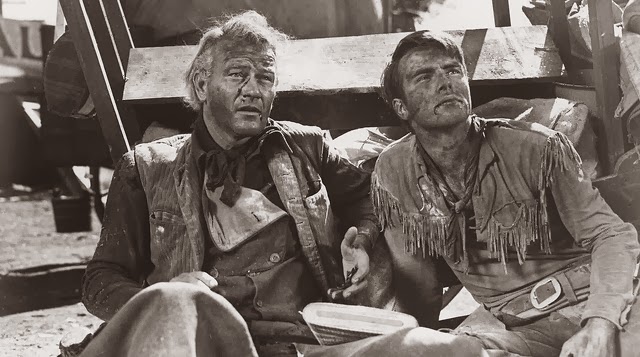
Red River is one of the finest classic Hollywood westerns ever made. The jack of all genres Howard Hawks, who also directed the great western Rio Bravo, directs it. John Wayne starred in both; he probably gives his finest performance in Red River.

The film unlike many pre-60s westerns doesn’t have the racial stereotypes that populate the film of let’s say John Ford. That’s not a dig at John Ford who was a mighty fine director in his own right but Hawks was a much more sophisticated director when it came to his subject matter. Orson Welles once perfectly described the different between Hawks and Ford “Hawks is great prose; Ford is poetry". Ford’s films were more about the poetry and mythology of the west while Hawks’ films were based on the true west.

Red River is based on a news article about the first cattle drive from Texas to Kansas along the Chisholm Trail. It’s set after the end of the American civil war and the South is too poor after loosing the war. Thomas Dunson must lead a group of men including his adopted son Matthew Garth (Montgomery Clift) to move his massive herd of cattle to Missouri.

Dunson is determined to get to Missouri but he is told by many people on the way that the railroad has reach Abilene, Kansas. He instantly dismisses these claims because none of the people have actually seen the railroad. He becomes increasingly merciless in his control over the men and naturally a rebellion starts to grow.

The film is expertly told by Hawks with book passages to fill you in, it moves a very solid pace though out. Hawks after all directed one of the fastest moving films ever made His Girl Friday. The cinematography by Russell B. Harlan is outstanding with stunning point of view shots from inside the carriages. The only real flaw in photography is some of the rear projection is bit dodgy at times; it was clearly shot as pick-up after the location shootss. Harlan also shot To Kill a Mockingbird later in his career along with many films for Hawks like The Thing.

John Wayne’s performance is widely considered one of his finest if not his finest. He was never known for his great acting ability but he gives a fascinating psychological portrayal of a tyrant. The only other performance he gave that comes close would be The Searchers. Red River was only Montgomery Clift’s 2nd film role and was the one that really made him a star and it’s a great performance. Walter Brennan is great as usual; he is really the quintessential character actor of the first half of the 20th century he was literally in everything from Bride of Frankenstein, Swamp Water, Meet John Doe, To Have and Have Not and countless westerns.

The film has some hilarious gay subtext to a modern audience. It’s widely known now that Montgomery Clift was bisexual. The scene that makes the gay subtext very overt is when Cherry Valance (John Ireland) appears and is clearly eying up Matt and they have an exchange involving such lines as “Can I see your gun?” and “Would you like to see mine?” Dunson and Matt’s relationship is also rather suspect especially with the line at the end after a fight between the 2 a woman says “Everybody can see you love each other” There is also barely any women in the film and even they appear and the love interest is basically there just to verbalise the tension between Dunson and Matt.

Red River is possibly the finest western of the Golden age of Hollywood with great performance, expert storytelling, fantastic cinematography and priceless gay subtext. Masters of Cinema has done a very fine Blu-ray release even though a few more bonus features would have been nice.

★★★★★

Ian Schultz

23 October 2013

Tobe Hooper Double Bill - Lifeforce & Texas Chainsaw Massacre 2 Blu-Ray Reviews

No comments:

Rating:
18
Release Date:
14th October 2013
Director:
Tobe Hopper
Cast:
Steve Railsback, Mathilda May, Peter Firth
Buy Lifeforce: Blu-ray


Rating:
18
Release Date:
11th November 2013
Director:
Tobe Hooper
Cast:
Dennis Hopper, Caroline Williams, Jim Siedow
Buy Texas Chainsaw Massacre 2: Blu-ray


The great Arrow Video has re-released two mid 80s Tobe Hopper films, both were part of his 3 picture deal with Cannon films. The films in question are Lifeforce and the unthinkable sequel to his masterpiece The Texas Chainsaw Massacre. He got the deal after the massive success of the overrated Poltergeist, which we all know Steven Spielberg really directed anyway.

Noted British occult, sci-fi and crime writer Colin Wilson novel The Space Vampires is the basis for Lifeforce. When he saw the finished film he famously called up John Fowles who cited his the adaptation of his book The Magus as the worst film adaptation ever, he told him there was a new one Lifeforce. I have never read Wilson’s source novel so I can’t comment if that’s the case.

Anyhow the film is a pretty naff bit of horror sci-fi, it was suppose to be a big budget franchise starter but it bombed quite badly. It’s about a group of astronauts who discover some space vampires in this spaceship hidden in the corona of Hailey’s Comet. Everything goes to shit and a rescue mission is launched and the 3 bodies they found in the spaceship but they look human.

They start to operate on them but they are actually still alive. Despite everything going to shit and the rest of the crew dying, one escape pod gets back to earth (it all seems to be a matter of days) with Colonel Tom Carlson. The Colonel is flown to London (which seems to be only a matter of hours) and warms them of what happened and has a psychic connection to the girl who is one of the bodies. The Space vampire girl breaks free and sucks the souls out of people for energy and England brings in Martial law. It’s called Space Vampires but they more resemble Zombies than vampires.

It’s a passable bit of sci-fi/horror fluff. It has some nice matte paintings and special effects, some terrible acting but it’s about 30 minutes too long for it’s good and is quite a chore at times to get though. The end space vamp zombie apocalypse is gleefully batshit crazy which it gets some props for that. It’s one of many misfires in Tobe Hopper’s career every since his made such a splash with The Texas Chainsaw Massacre, which brings us too…


The Texas Chainsaw Massacre 2 is one of the strangest sequels ever made. It is much in tune with something like Evil Dead 2 than its almost cinema vérité style of the source material. It takes place 13 years after the events of the first Texas Chainsaw Massacre. It starts with almost parody voice over of the first film which gets increasing fast telling you what has happened in the 13 years. It many ways like Evil Dead 2, it’s a retread of the first film. The family having a chainsaw killing spree across Texas and it even has a redo the famous dinner scene from the original.

The film starts with Leatherface killing a bunch of yuppies on the freeway an obvious political statement. The yuppies are harassing a local female radio dj called Strech (Caroline Williams) who records their death on tape. Dennis Hopper than shows up in probably one of his most unhinged performances ever and this is a guy who made a career out of them. He is Lieutenant Boude "Lefty" Enright who is the uncle of Sally and her brother (the guy in the wheelchair) from the original film. The police have been incompetent in bringing the Sawyer family so he is on a mission to find the killers of his niece and nephew.

Strech plays the tape on air so the police are forced to listen to it but the Sawyers hear it and Leatherface and his acid casualty Nam’ veteran Chop Top comes to kill her at the radio station. The film becomes a total bloodbath from this point onwards. She survives and teams up Lefty to finish the Sawyer family for once and for all. Lefty brings a lot of chainsaws.

The film is fascinating mess of a film in the best possible way. It’s a deliberately surreal film from the get-go, which is as different as you can from the original. This may be one of the many reasons why the film was probably panned when it first came out. It has a great 80s aesthetic, which is partly inspired by his previous film The Funhouse, The Sawyers live a disused theme pack out in the desert. It’s all day-glow and obvious a good chunk of the budget when on the almost German expressionist esq. design of their underground home.

TCM2 is a deciding more political film as well even though the original is very much a post-Nam/Watergate film as much as any other 70s film. It is damning on everything from the treatment of veterans, 80s greed, consumerism and so on. In an interview with Tobe Hooper says he considers it one of the finest political films of the 80s and the guy has a point. Horror a genre not known for being particularly political if not somewhat dodgy politically it’s refreshing for a film of this kind to be so political. The award winning human chilli scene definitely brings back memories of Soylent Green.

Dennis Hopper is so insanely unhinged it’s almost mindblowing he was directed if at all. It’s also worth noting this was after he got “sober” he seems to have had a cocktail of blow and Frank Booth’s helium. It’s kind of a glorious bit of over acting to other side and then some. This was after all the same year as Blue Velvet.

It’s misfires often with it’s zany but extremely black humour. It often does Felliniesq retrends of scenes from the original film but it has a certain bizarre 80s charm that make it worth while and it’s only like 90 minutes. It’s probably his best film since the original film as well.

Both discs include loads of bonus material including feature length docs on Lifeforce and TCM2, numerous interviews, 2 different cuts of Lifeforce (theatrical and director’s), commentaries. TCM2 also includes early films made by Hooper including a rare bland comedic short and feature length film on hippies. I recommend TCM2 but if you’re a fan of Lifeforce you will be overjoyed with it’s blu-ray.

Ian Schultz


Lifeforce


★★½☆☆


Texas Chainsaw Massacre 2


★★★½

19 October 2013

Nosferatu (1922) Masters Of Cinema Review

No comments:


Rating:
PG
Release Date:
25th October 2013 (UK Cinema)
Distributor:
Eureka! Video, BFI
Director:
F.W. Murnau
Cast:
Max Schreck, Greta Schröder, Ruth Landshoff


It's easy to call yourself a film fan or even a cinephile but when you dig a little deeper to find out why they call themselves fans its then you truly find out how much of a fan you really are. Film is one of the most culturally diverse art forms ever created, true cinephiles will appreciate it in all it's forms including Silent Film. With Halloween creeping up on us what better time to (re-)release of the most iconic horror  films in cinematic history getting a rare appearance on the big screen, F.W Murnau's Nosferatu (1922).

Whilst Bela Lugosi then Hammer Films romanticized that many of us perceive Dracula to be, the reclusive black cloaked fanged count  who has women falling at his feet ,under his hypnotic spell, Murnau's masterpiece is film's earliest adaptation of Bram Stoker's novel seen on the big screen.

Set in post world war one Germany, Nosferatu sees Knock (Alexander Grauach) a estate agent and his assistant Hutter (Gustav Von Nagenheim) go on assignment deep into the mysterious Carpathian Hills in heart of Transylvania. They arrive at Count Orlock's castle (Max Schreck)to broker the sale of Orlock home back in Germany but as the days fly past Hutter starts to notice unusual things start to happen he reverts back to the book he is reading Orlock might actually be a vampire. As the horror of realization sinks into Hutter he discover Orlock has escaped his castle back to Germany amongst a shipment of coffins leaving a trail of death in his wake forcing Hutter to Hunt the parasitic killer before a veil of death destroys his hometown.

To be screened part of BFI's Gothic The Dark Heart Of Film,Nosferatu deserves its rightful place next to modern horror, frankly because of its superior quality. The film might be 9 years short of been 100 years old some may call it outdated, cliched but in reality this film's craftmanship, technical ability are second to none. This film is essential viewing for any wanna be horror filmmaker though scare factor maybe non-existent but the visual power and atmosphere stands up against any modern horror film making one of the best with the genre (possibly best within Vampire sub genre). The shadowy silhouettes, male leads exact doubles of each other, broody Gothic horror in its prime but most of all make up the symbolic German Expressionism.

If there's any case for the importance of music within a feature film, the silent film era will act as your best case to support your argument. Nowdays it seem many bands fight to get a hip points however like when you talk about football matches the crowd been the '12th Man' the score is that '12th Man' providing the heartbeat of the audience delivering an extra dimension of fear, tension. Even with a modern score Nosferatu never loses it's power still delivers the platform for Max Schreck to deliver the ultimate legendary performance as Count Orlock.

Schreck's portrayal of Orlock was delivered with such conviction, terrifying passion by an actor who actually believed he was a  vampire. There is no comparisons from any other  actor coming close to matching Schreck,but the closest comparsions could possibly be seen in two  more recent films, the highly underrated Shadow Of The Vampire (2000) and Werner Herzog's Nosferatu The Vampyre (1979) with Klaus Kinski.

So why has Stoker's legendary creature of the night always been romantized rather been a predatory monester, one a argument comes from film historians with the possibe connections with Nazism. Whilst the film was created well before the rise of the Nazis Nosferatu is believed by some to be an account based around the Weimar Republic. A state within Post World War One Germany born out off corruption, anti antisemitism delivering the National Socialist Party  but it's the visual attributes of Orlock that could be seen as the most terrifying. The Nazis looked to have hijacked Murnau's vision for how they symbolized the Jewish people as rat like creatures for their propaganda films. If anything the main argument could all be down to Bram Stoer's widow taking the German auteur to court for breach of copyright despite the change to the novel

Whatever your think about Nosferatu, it may not feel part of modern romantic vision of the vampire but it has it's rightful place in horror folklore. When you look back at the story of how Murnau's masterpiece was created it makes you wonder did  he know something we didn't know when he kept that single copy despite the court order to destroy all copies. Though sometimes if he had a time machine he may have thought twice about destroying the remaining if he knew that Twilight Saga lay ahead?! Whatever you think or how many versions of the film you may have on DVD or Blu-Ray  F.W Murnau's Nosferatu was made for one thing, that's the big screen, don't miss a piece of cinematic gold getting a rare run on the big screen.

★★★★★

Paul Devine


18 October 2013

The Night Of The Hunter (1955) Blu-Ray Review

No comments:

Rating:
12
BD Release Date:
28th October 2013 (UK)
Distributor:
Arrow Academy
Director:
Charles Laughton, Robert Mitchum
Cast:
Robert Mitchum, Shelley Winters, Lillian Gish,
Buy:
The Night of the Hunter On Blu-ray [Amazon]

Jeffrey Couchman wrote in his book The Night of the Hunter: A Biography of a Film that “Charles Laughton’s The Night of the Hunter is at once a fairy tale, a horror film, an allegory, a thriller, a mixture of realism and stylization that even now is hard to define”. The Night of the Hunter was the only film Laughton ever directed, even though he is sometimes compared to Orson Welles because of his work as an actor, theatre director and this film.

The Night of the Hunter was made during the tail end of the film noir period and is often considered a film noir even though it doesn’t fit all of the characteristics of that genre—for example, it is not an urban film but city settings are usually said to be a key component of film noir.
Laughton had been doing a one-man reading tour that was very successful, and had been a stage and film actor for some years. He was working with producer Paul Gregory, who “I wanted to bring Charlie into focus as a top [film] director and eventually quit performing”. Gregory passed the galleys of the script on to Loughton, who agreed it was a good choice as his first film. Gregory had bought the rights to the book before it was published The film is about a self-appointed Preacher, Rev. Harry Powell, played by Robert Mitchum, who becomes a father figure to two children whose father (Ben Harper, played by Peter Graves) he knew in prison. He starts a relationship with their mother because he is after hidden money that his cellmate told him about. The father had been sentenced to hang for taking part in a robbery. Importantly he only has one clue to help him find it, a Bible verse: “and a child shall lead them.” It is based on a novel by Davis Grubb, which was inspired by a true story.

The Library of Congress has placed The Night of the Hunter in the National Film Registry in the US, and it has merited a release in the Criterion Collection which specializes in “continuing series of important classic and contemporary films”; It got decent reviews at the time, and it had very good production values despite a medium-sized budget ($795,000) about double the typical film noir, partly because Mitchum was a very big name The way it was shot has been influential on many filmmakers since. It was not a massive disaster, but there were financial losses. United Artists sold off the TV rights very fast to try to make some money. This made it one of the earliest films to be rediscovered because it ran on television, similar to what happened with the film The Manchurian Candidate also released by United Artists. It was later remade for TV.

The author of the original book, Davis Grubb, did a lot of surreal, expressionistic drawings for the film and these probably had a strong influence on Laughton’s ideas about what the film should look like. “Although Laughton never talked about expressionism with the crew… Laughton’s constant point of view was to project the tale of a very real preacher against a surrealistic fabric,” Jeffrey Couchman wrote in his book. “Dennis Sanders remembers that Laughton talked to him about creating a film in which each of the actions had to be larger than they would be in life, not trying to create a realistic picture but an expressionistic picture.” However there is no record that he actually studied expressionist film in his research for Night of the Hunter. He did screen The Four Horsemen of the Apocalypse and Greed but the director Laughton looked to the most was silent film director D.W. Griffith. Griffith was the director who invented most early editing techniques so most directors will be referencing him intentionally or unintentionally. His lighting techniques were also very influential.

To make Laughton’s vision happen, production designer Hilyard Brown created stylized sets, and the cinematographer Stanley Cortez played up light and shadow to create mood. For example, the scene in which the Preacher kills the children’s mother Willa uses visuals that create a non-realistic mood. The room is established using a medium shot and looks realistic at first. However the room has a peaked roof that makes it look like a church. There is more religious symbolism, where a doorway is lit to look something like an altar, and long shots show the bedroom where she is killed lit like a cathedral.

The religious imagery works on three levels: a) it’s ironic because the Preacher is actually evil, b) it conveys the point of view of both Willa and Preacher, and c) Willa believes her murder will be her salvation. What the viewer sees is meant to be how the Preacher conceives of the scene in his twisted mind. Another example is the scene in which the children escape the Preacher in a rowboat. You see the Preacher coming after the children from their point of view as he is trying to get through bushes and then the water with a knife in his hand. A two-shot of the children in the boat cuts to a long shot of the boat in the river under a sky of obviously fake stars. Laughton said he wanted this sequence to look like a photo book and it serves as “a signal that we have entered a universe of abstracted reality” said Couchman in his book. Roger Ebert has also written about this scene: “the masterful nighttime river sequence uses giant foregrounds of natural details, like frogs and spider webs, to underline a kind of biblical progression as the children drift to eventual safety.”

The part of the film where they are on the river is also silent so it is a really obvious example of the influence of German expressionist silent films on Laughton. Like in films such as The Cabinet of Dr Caligari, Laughton uses sets that are obviously unreal to create feelings. Couchman wrote “Laughton distorts reality to project a childs-eye view of the world” The film was shot almost entirely in a studio not on location. As in the case of Frances Ford Coppola’s film One From the Heart, this technique adds a layer of artificiality to the film. It was not an uncommon technique at the time, but especially at that time in the film noir genre this was unusual—Kiss Me Deadly was a more typical example, as a location film in which the location is essential to the film in the same way that the artificiality of The Night of the Hunter is vital to its theme.

Another influence on the look of the film was the classic horror and science fiction films that Laughton acted in, such as Island of Lost Souls, Hunchback of Notre Dame as well as the Universal horror films, especially Frankenstein and Dracula. Laughton uses some shots that are similar to the ones used in these types of films to set up a fearful feeling in the audience. Cortez had worked with Orson Welles on The Magnificent Ambersons before making this film and later worked with Sam Fuller on Shock Corridor and The Naked Kiss. He had met Laughton when he took over cinematography on Man on the Eiffel Tower. He was a very meticulous cinematographer—Welles had called him a “criminally slow cameraman” but he worked fairly quickly on this film from all acounts. Cortez said “of all the directors I ever worked with only two understood light: Orson Welles and Charles Laughton”.

Many shots are from a child’s eye view because it is essentially told from the point of view of John, the boy, so this makes it clear without the character or a narrator having to say so. It also helps you identify with this character because you are seeing events through his eyes most of the time.

The film is very much ahead of it's time and Couchman said “For viewers schooled in the films of the 60s and 70s, The Night of the Hunter appears less peculiar than it did on its first release". Another writer one wrote “Laughton’s use of typical film narrative but with arthouse narrative strategies techniques would not seem as strange to a viewer who has seen a post-French new wave gangster”.

In conclusion, looking at the way shots, lighting, sets and the characters appearance has been set up by the director and the people working with him makes it clear that there is more to creating a really powerful film than just a good script. Because Laughton thought through all these details thoroughly, the film works on several levels and has a fairy tale/horror quality that makes it a more artistic film than it would have been if it had been done as just a crime story. It is one of the most beautiful films to look at ever made and features such a great performance from Robert Mitchum in probably his most iconic role. Arrow Video has done a very fine blu-ray transfer loaded with lots of bonus features including 2 and a half hours of making of footage.

★★★★★

Ian Schultz


Let's Go 'Trippin' With Short Film Trailer For Amnesiac On The Beach

No comments:
We're not immortal though some of us think we are. We are born on a certain day, certain year and soon enough a certain day of a certain year in the future we ill die and that's a fact but what if what we do, see or know was one big hallucination? Dalibor Baric's Amnesiac On The Beach short film invites you to go on one  big hallucinating 'trip' if we were never to act, never to desire, never to experience anything new? Now we can give you the most precious gift of all: The Near Life Experience.

This experimental short film  is taken from the short film selection from Sigtes Film Festival, check out the trailer below, the visual aspect is worth 75 seconds of your time, we do dig the downtempo Air-esque/DJ Shadow score too!


In a dead and void dystopian world, where permanent present reigns and absorbs like a black hole every past as well as every future, there is a place where no one exists anymore and everyone is just their own hallucination on the verge of disappearing

source: Bonobo Studio

Prince Avalanche Review

1 comment:

Rating:
15
Release Date:
18th October 2013 (UK)
Director:
David Gordon Green
Cast:
Paul Rudd, Emile Hirsch, Lance LeGault

David Gordon Green’s output has been markedly spasmodic over the years, with a career that has followed up the gracefulness of George Washington with the odd, bleakness of Snow Angels and the tactless inanity of Pineapple Express and The Sitter. Happily he is in more contemplative mood with Prince Avalanche, his remake of 2011 Icelandic comedy Either Way which steers him right back down the path of meandering indie-sensibility.

Paul Rudd and Emile Hirsch are a bummed-out pair of puffins working to repaint the road markings in the rural, fire-damaged Texas countryside. Rudd is Alvin, the pensive - yet explosive - elder statesman, pining for the company of his girlfriend from whom he routinely departs for weeks at a time to find solace in his work and solitude. Hirsch is Lance, the naive brother of the girl in question, tagging along for the ride, the pay and Alvin’s hope that the experience will impart some sort of worldly wisdom into a mind, as yet, interested largely in tits.

The pair’s work is occasionally interrupted by a benevolent, beer-wielding truck driver; Lance departs for a weekend of casual sex while Alvin fishes and mediates amongst the burnt-out ruins of the houses scatter the area.

Whether this slow-burning walking-movie will work for you will depend quite squarely on your ability to warm to this pair of underachievers, so intently focused is the narrative on their brotherly joshing and complaining.

I’ve suspected that Rudd may have something of the air of genius about him since he deftly and effortlessly caught my eye in Our Idiot Brother and his performance here is as naturally endearing as that, if not more so. Alvin inhabits a universe which is in turn inhabited by regret and misfortune; Rudd’s capacity to convey pig-headed insecurity and denial, tempered with genuine amiability is wonderful. Hirsch’s obnoxious, frivolity is a counterbalance, but a welcome one, and the resulting two-handed stream of petty nitpicking giving way to good honest love is utterly charming.

Chuck in a score from Explosions in the Sky which tidily and sweetly underlines the fraught, tetchy, but ultimately tender arrangement and it all amounts to something which very nearly convinces you pack your own bags, grab a comic and head for the woods yourself.

★★★★

Chris Banks


17 October 2013

Time To Check In And Watch Wes Anderson's The Grand Budapest Hotel Trailer!

No comments:
Say what you like about Wes Anderson personally he is one of the many reasons why I love Arthouse/Independent film. Colourful, vibrant, off-kilter, witty most off all charming and tonight we finally get our first look at his next chapter of his visual journey into film The Grand Budapest Hotel!

The Grand Budapest Hotel recounts the adventures of Gustave H (Ralph Fiennes), a legendary concierge at a famous European hotel between the wars, and Zero Moustafa, the lobby boy who becomes his most trusted friend.

All the trademark Wes Anderson traits are here as expected, same with many of the regular cast as well as many new faces, but most of all its essential Anderson and that's all cinephiles need to know!


No official UK release date has been confirmed however US date is set for Easter 2014 so expect the same or late Spring.

The Grand Budapest Hotel also stars Jude Law, Bill Murray, Jason Schwartzman, Saoirse Ronan, F. Murray Abraham, Jeff Goldblum, Willem Dafoe, Adrien Brody, Owen Wilson, Edward Norton, Harvey Keitel, Léa Seydoux, and Mathieu Amalric.

Horror Channel celebrates British horror classics with a Brit-cult season

No comments:
November on Horror Channel sees network premieres for a memorable collection of strange cult oddities and forgotten British horror classics, kicking off with the network premiere of Nicolas Roeg’s THE MAN WHO FELL TO EARTH, starring David Bowie. Joining Bowie in the realm of the weird and wonderful is Roy Boulting’s psychological ground-breaker TWISTED NERVE, Michael Powell’s controversial PEEPING TOM, Robert Fuest’s Hitchcockian AND SOON THE DARKNESS and Jimmy Sangster’s Hammer classic FEAR IN THE NIGHT.

Also, there are UK TV premieres for Emmerdale actor Dominic Brunt’s directorial feature film debut BEFORE DAWN, Lulu Jarmen’s disturbing BAD MEAT and Padraig Reynold’s festival favourite RITES OF SPRING.

Fri 1 Nov @ 22:55 – THE MAN WHO FELL TO EARTH (1976)

Based on the 1963 novel of the same name by Walter Tevis, this cult classic stars David Bowies (in his debut film role), as an extraterrestrial who crash lands on Earth seeking a way to ship water to his planet, which is suffering from a severe drought. It also stars Candy Clark, and Hollywood veteran Rip Torn and is produced by Michael Deeley and Barry Spikings, who reunited for work on another epic, The Deer Hunter.


Fri 7 Nov @ 22:55 – AND SOON THE DARKNESS (1970)

Starring Pamela Franklin and Michele Dotrice this on the edge of your seat thriller, tells the story of two young English women on a cycling holiday in the French countryside. Cathy, distracted by a local man, parts company with Jane. When her friend fails to rejoin her, Jane returns to the last place she saw her. Cathy has vanished. Alone and with a limited knowledge of French, Jane frantically searches for her missing friend.


Fri 15 Nov @ 22: 55 – TWISTED NERVE (1968)

Director Roy Boulting brings out the best in actor Hywel Bennett, who plays Martin, a disturbed young man with a dysfunctional mother and a cold-hearted step-father. Martin, pretends, under the name of Georgie, to be mentally retarded to be near Susan (played by Hayley Mills), a girl he has become infatuated with, killing those who get in his way. But when Susan rejects him, she becomes the next target.


Fri 22 Nov @ 22:55 – PEEPING TOM (1960)

Peeping Tom stars Carl Boehm as Mark Lewis a part-time photographer who is a serial killer, murdering women while using a portable movie camera to record their dying expressions of terror. The film's controversial subject and the harsh reception by critics effectively destroyed Michael Powell's career as a director in the UK. However, it attracts a cult following and is now considered a masterpiece.


Fri 29 Nov @ 22:55 – FEAR IN THE NIGHT (1972)

This psychological horror thriller follows a young woman (Judy Geeson), recovering from a nervous breakdown, who takes up a new position working in a boys' boarding school. She soon begins to believe she is losing her mind when she starts being terrorised by a one-armed man. Directed by Jimmy Sangster and produced by Hammer Film Productions, it also stars Joan Collins, Ralph Bates and Peter Cushing.


Wed 6 Nov @ 22:55 – RITES OF SPRING (2011) *UK TV premiere

After kidnapping the nine-year-old daughter of a wealthy socialite and hiding out in an abandoned school, a group of kidnappers falls prey to a recurring terror, a bloodlust that comes every first day of spring. Part kidnap heist, part slasher movie, this is director Padraig Reynolds’s feature film debut, which scored highly on the festival circuit. It stars AJ Bowen, Anessa Ramsey, Sonny Marinelli and Katherine Randolf.


Wed 20 Nov @ 22:55 – BAD MEAT (2011) **UK TV premiere**

In Canadian director Lulu Jarmen’s splatter sensation, a boot camp for troubled teens becomes a nightmarish charnel house when spoiled meat transforms the staff from sadistic fascists into something much, worse. Get ready for spilt blood, vomit, faeces and bile – in the strangest, weirdest destined-for-cult-dom in ages. Stars Elizabeth Harnois, Dave Franco, Mark Pellegrino, & Jessica Parker Kennedy


Sat 23 Nov @ 22:55 – BEFORE DAWN (2012) * UK TV premiere

Dominic Brunt, better known as veterinarian Paddy Kirk in ‘Emmerdale’, has written and directed a terrific zom-rom horror. Alex (Dominic Brunt) and Meg (Joanne Mitchell) go for a weekend in the Yorkshire countryside in an effort to save their relationship. Unfortunately the picturesque holiday area chosen comes under attack from the walking dead and Meg is soon going to find out the depth of Alex’s love.


Plus there are network premiers for Brian Yuzna’s RETURN OF THE LIVING DEAD 3 (1993), Sat 2 Nov, 22:40; David Lynch’s MULHOLLAND DRIVE (2001), Sat 9 Nov, 22:55; Jonathan Levine’s ALL THE BOYS LOVE MANDY LANE (2006), Sat 16 Nov, 22:55 and Greg McClean’s WOLF CREEK (2005), Sat 30 Nov, 22:50.

TV: Sky 319 / Virgin 149 / Freesat 138

www.horrorchannel.co.uk | twitter.com/horror_channel

15 October 2013

Watch Official Trailer For Japanese Drama The Little House (Chiisai Ouchi)

No comments:


It's amazing how many people romanticize about such TV Shows like Downton Abbey but when a similar type of film for the cinema is released we seem to turn our noses up at it. In Japan things are alot different, period films are embraced like The Little House (Chiisai Ouchi) which is set for a  early 2014 release  and today we can enjoy the film's first trailer.

Directed Yoji Yamada and based on award winning novel by  Kyoko Nakajima The Little House  is based around a love affair set in 1920's Tokyo. Taki (Haru Koruki) a young woman who works as a maid for a Toy company employee Masaki who lives with his wife Tokiko (Takako Matsu) and 5 year old son. Over several visits one of Masaki's  collegue Shoji who sparks a love affair with Tokiko, an affair Taki observes quietly but now 60 years on she now reveals her version of the affair.

The film sounds very elegant, visually the sets, costumes look wonderful, whilst the trailer may consist of mostly dialogue we may not understand you can see why period drama is still very popular in Japan. The Little House is due a 25th January 2014 release in Japan.


suource: NipponCinema